
PRODUCT SEARCH
Find high performance, low impact materials for your building project.
Planning and Design
Specifications, technical guidance and design resources for architects, contractors and specifiers. Everything you need to make informed decisions before work starts on site.
Start here.
Not sure what to dive into first? We recommend starting with these...
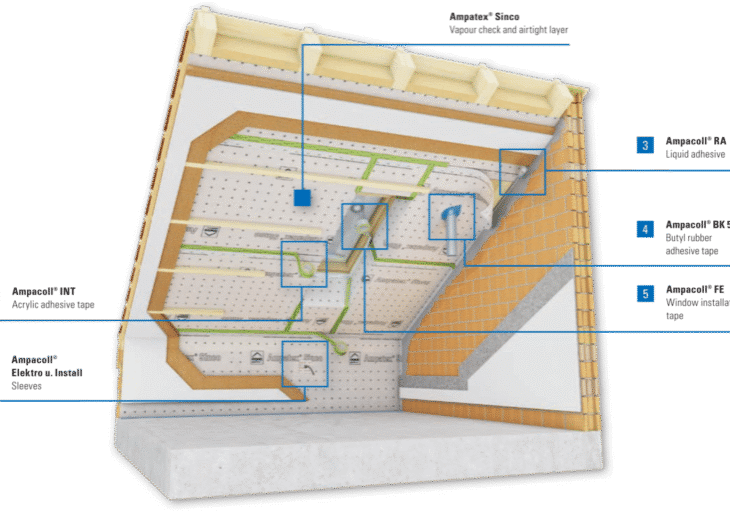
What is a vapour control layer?
Learn what a vapour control layer is, how it works, and why it matters. Is vapour check plasterboard an alternative?


NatureWall Information Pack
Downloadable files and resources taking you through all the checks planning for NatureWall projects.
Fire and wood fibre
One common concern when using wood fire insulation is that because it is made of wood it might not be safe from a fire perspective.
Explore all resources under Planning and Design...
Industry news

https://youtu.be/DTZuZx_Pk4s
A tight retrofit budget means you can't tackle everything at once, so knowing where wood fibre insulation earns its place first really matters. In the latest Can I Just Ask, the conversation runs through where to prioritise, starting with year round comfort up in the roof and moving through the walls and floors where wood fibre's moisture and thermal properties really come into their own. There's also a look at why the material that seems cheapest on paper doesn't always work out cheapest over the life of a building.
Industry news
https://youtu.be/3-YHD-wQ_MU
Yes, technically — but it depends where and why. In flat roofs, a hybrid build-up can work well, such as XPS beneath the roof covering augmented with wood fibre in the rafter zone (subject to project-specific analysis). In pitched roofs, swapping in some PIR can reduce thickness while still hitting your target U-value, but every factor besides U-value — thermal mass, acoustic performance, fire performance — tends to get worse, so sticking with one material is usually the better call. Where the two abut, such as a wood fibre wall meeting PIR or XPS elsewhere, there's no issue as long as each specification is consistent and the junction maintains continuity of the insulation and airtightness layers.
Industry news

https://youtu.be/A7otP3FHdCY
Positive input ventilation (PIV) is popular in retrofit, but it isn't a good match for internally insulated walls. Pressurising the building pushes moisture laden air into gaps in the fabric, where it can condense on cold surfaces behind the insulation and cause hidden mould and decay. Balanced systems like MVHR, or simple extract ventilation, avoid this pressure build up and are a safer choice for buildings with internal wall insulation.
Industry news

https://youtu.be/lCclTxAS3ko
Flat roofs are one of the trickiest roof types to get right, and the covering you choose sits at the heart of whether they perform safely over time. In this episode, Chris and Andy look at what roof coverings work best with unventilated flat roofs, covering everything from SD values and membrane types to why the colour of your roof covering has a direct impact on moisture drying during the summer months. If you're specifying a flat roof build-up with wood fibre insulation, this is an essential watch before you commit to a membrane.
Industry news

https://youtu.be/5AH_I1_Am1I
Retrofit insulation rarely fails in the middle of a wall panel — it is the junctions, apertures, and service penetrations where things go wrong. In this episode, Chris and Andy dig into the details that most commonly cause failures in practice, from incomplete airtightness membranes to poorly handled window reveals, and why a 30% failure rate in IWI schemes is almost always a detailing problem rather than a system one. If you are specifying or installing internal wall insulation, this one is worth your time.
Industry news

https://youtu.be/pppC6-IsT94
In this episode, Chris sits down with Andy to tackle a question that's become increasingly relevant after last week's 30°C+ temperatures across the UK — why do well-insulated homes still overheat? Andy explains that U-values, while important, are just one piece of the puzzle, and that a singular focus on thermal conductivity often leads to buildings that perform well in winter but become uncomfortable in summer. He walks through the key factors at play — airtightness, window orientation, and crucially, the thermal properties of the insulation itself — and makes the case for wood fibre as a material that genuinely addresses the overheating problem. With a decrement delay of over 16 hours compared to around two and a half for fibreglass, wood fibre slows heat movement through the fabric dramatically, meaning peak external temperatures never really make it inside. A timely watch for anyone who's been sweating in a supposedly energy-efficient home.
Industry news

https://youtu.be/ZblFjoIQG4E
In this episode, Chris sits down with Marion for her first appearance on Can I Just Ask, talking about PAS2035, a subject that is well within her wheelhouse as a retrofit specialist. Marion explains that PAS2035 is a framework designed to make sure retrofit projects are delivered properly, from initial assessment all the way through to post-occupancy evaluation, with the right people involved at every stage. She walks through the key roles (retrofit coordinators, retrofit designers and installers working under the companion standard PAS2030) and clarifies that the scheme only applies to government-funded projects like ECO or Warm Homes Grant. It is a clear, jargon-light breakdown of a framework that affects a huge amount of retrofit activity in the UK but rarely gets explained in plain English.
Industry news

https://youtu.be/gqN-Q3Hf3ow
The priority when preparing walls for IWI is achieving full, continuous contact between the insulation and the wall surface — which on undulating masonry means a levelling coat first. The important first principle, however, is not to strip existing plaster as a matter of course: sound, well-bonded plaster can often be retained, and removing it to replace it with something similar is wasteful and potentially damaging to the masonry. The decision on what to keep should be informed by hygrothermal modelling rather than habit. Whatever is retained, a fungicidal wash over the wall surface before installation is essential — mould and fungal spores are present on virtually every wall even where invisible, and once the insulation goes on that surface is sealed behind the cold side of the build-up permanently.
Industry news
https://youtu.be/-KkXDBjzdEs
Wood fibre insulation cannot be applied to walls that are actively wet — it buffers and manages moisture within a normally functioning wall, but it is not a fix for an existing ingress problem. The source of any moisture must be identified and resolved, and the wall allowed to dry to a sensible level before insulation is installed; a thoroughly saturated wall may need close to a year to reach a suitable moisture content. The one exception is where apparent dampness is a surface condensation effect rather than true ingress — in that case, a modest insulation layer can raise surface temperatures above the dew point and resolve the issue, though improved heating and ventilation practices may achieve the same result without any fabric intervention at all.

Industry news

https://youtu.be/ff23GTCRuEo
Interstitial condensation occurs when internal wall insulation pushes the dew point zone inward to sit at the interface between the insulation and the cold wall behind — a genuine risk that needs to be designed out rather than ignored. With hygroscopic, vapour-permeable materials like wood fibre, moisture at that interface is adsorbed onto the materials vast internal surface rather than forming as liquid water, which changes the risk profile significantly compared to synthetic alternatives. Dynamic hygrothermal analysis rather than steady-state Glaser calculations is essential to understand what is actually happening — and the design goal is to keep conditions below the thresholds for both liquid condensation and mould growth, not just to avoid free water formation.