
PRODUCT SEARCH
Find high performance, low impact materials for your building project.
Design & Build with Wood Fibre Insulation - Learning Lab
Back to Earth's Learning Lab is our resource for designers and installers to help you learn all you need to know about how to design and build with wood fibre insulation. Explore articles, guides and practical knowledge designed to support better, more sustainable building decisions. Whether you’re researching a detail or solving a problem on site, you’ll find clear, reliable answers here.
Scroll down to explore, or jump straight in by searching below.
Popular Resources
Quick access to our top guides.
Looking for something specific? Click below to explore all of our Help Guides.
Browse Categories
Find the information you need.

Can I Just Ask?
Can I Just Ask? is our ongoing Q&A series where Chris and Andy from our technical team answer the questions we hear every day - from retrofit details to material performance and on-site challenges.
Short, clear answers designed to help you make better building decisions.
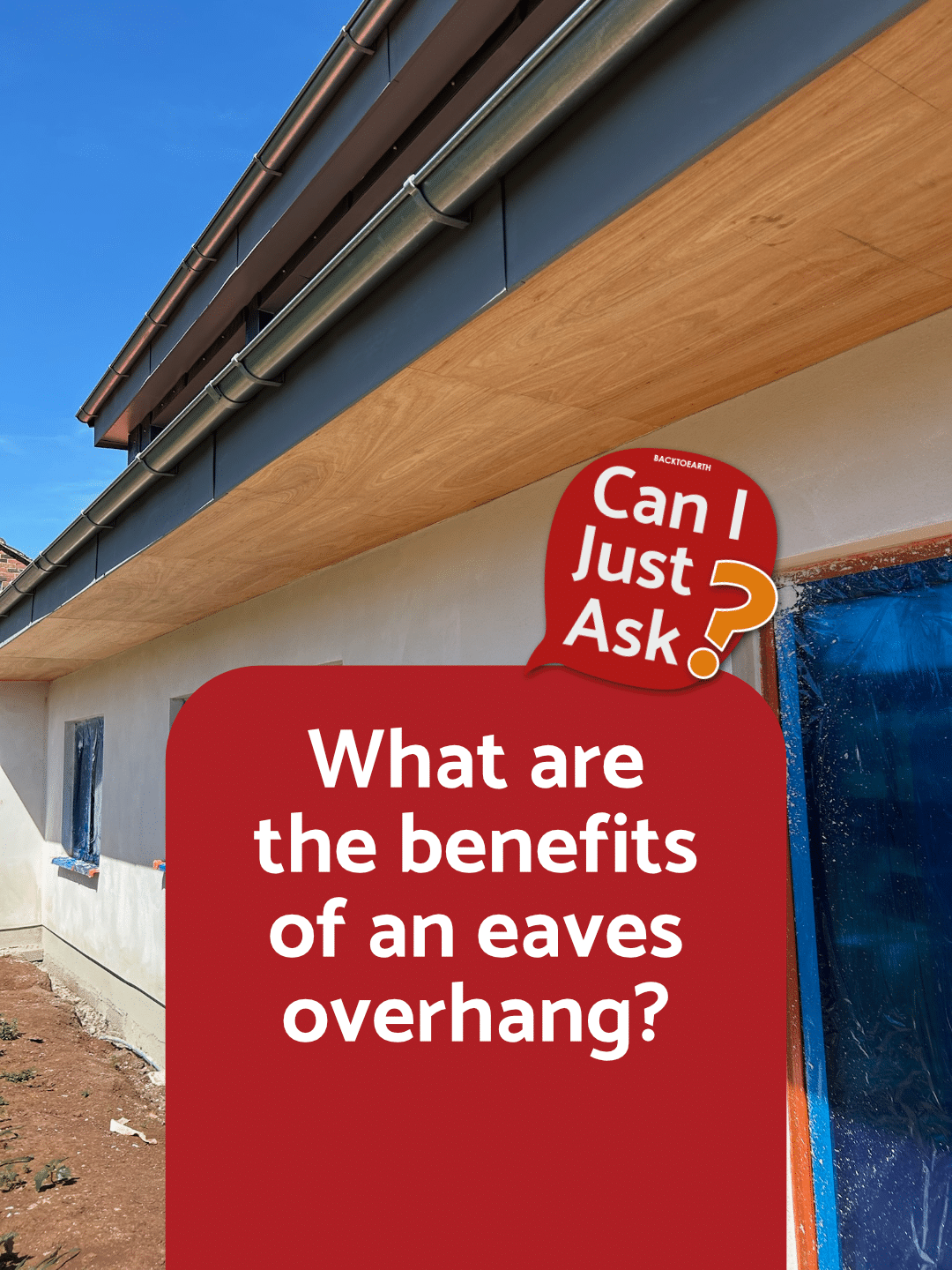
https://www.youtube.com/shorts/pYOQ8z4S6aY
Why do we like a big eaves overhang? Beyond the look, a deeper overhang keeps walls sheltered, helps finishes last longer and protects windows and sills from driving rain, while cutting down splashback at the base of the wall. It earns its keep in summer too. On our bungalow retrofit, the midday shadow sat just below the window sills at the height of the heatwave, keeping solar gain down and the inside cool.

https://youtu.be/EQvJT00-b4U
Heatwaves are no longer unusual in the UK, and buildings designed to keep heat in during winter often struggle to keep it out in summer. Chris and Andy work through what helps, from simple shading and night purging to airtightness, high-mass insulation in the roof, window strategy and where active cooling starts to make sense.

https://youtu.be/yqb3uu_BB30
In this episode of the 'Can I Just Ask?' series; Chris and Andy take on flat roofs, the most moisture sensitive roof construction there is, and the three ways we specify them with wood fibre. The ventilated build is the most robust but the deepest. The unventilated build is the slimmest and simplest to detail, though it relies on solar drying and rules out green roofs, solar panels and shaded sites. The hybrid swaps the wood fibre sarking for XPS to buy back that versatility, at a cost in embodied energy, thermal mass and decrement delay. Whichever you choose, the roof covering is still what determines whether it lasts.

https://youtu.be/o3eNnBZuoXA
Watch this episode of 'Can I Just Ask?' to find out how to handle window replacement after internal wall insulation has gone in. Ideally the existing building is made retrofit ready first, with the windows upgraded before any insulation work. In reality, time pressure or windows with a bit of life left in them often mean the old frames stay put for now. Chris and Andy explain how to detail the reveals so the insulation terminates properly against the new frame later, and how to keep the airtightness as intact as possible when the old window comes out.
https://www.youtube.com/watch?v=A2JILSXnnuo
In this video we look at what happens to internal wall insulation when a property floods. The real problem isn't the water itself, it's what the water brings in with it, and that changes what has to happen to the insulation afterwards. Find out in this episode of 'Can I Just Ask?'.

https://www.youtube.com/watch?v=ICJirHoFQHk
There's a persistent worry that internal wall insulation seals a house up so tightly it becomes unhealthy to live in. In this episode, Andy Banister and Chris Brookman unpack why airtightness and ventilation are two separate things, why a continuous layer of insulation actually helps prevent mould, and why a well sealed home is good for both comfort and health through winter cold and summer heat alike.

https://youtu.be/S38y7ZwwCe4
Ever noticed how a well retrofitted home just feels more comfortable, whatever the weather's doing outside? In this week's episode, Andy explains why two rooms at the same temperature can feel worlds apart, and how continuous insulation, airtightness and a good ventilation strategy keep you warmer in winter and cooler through a heatwave. He also gets into why wood fibre is so well suited to holding onto that overnight cool, often with no air conditioning needed at all.

https://youtu.be/DTZuZx_Pk4s
A tight retrofit budget means you can't tackle everything at once, so knowing where wood fibre insulation earns its place first really matters. In the latest Can I Just Ask, the conversation runs through where to prioritise, starting with year round comfort up in the roof and moving through the walls and floors where wood fibre's moisture and thermal properties really come into their own. There's also a look at why the material that seems cheapest on paper doesn't always work out cheapest over the life of a building.
https://youtu.be/3-YHD-wQ_MU
Yes, technically — but it depends where and why. In flat roofs, a hybrid build-up can work well, such as XPS beneath the roof covering augmented with wood fibre in the rafter zone (subject to project-specific analysis). In pitched roofs, swapping in some PIR can reduce thickness while still hitting your target U-value, but every factor besides U-value — thermal mass, acoustic performance, fire performance — tends to get worse, so sticking with one material is usually the better call. Where the two abut, such as a wood fibre wall meeting PIR or XPS elsewhere, there's no issue as long as each specification is consistent and the junction maintains continuity of the insulation and airtightness layers.

https://youtu.be/A7otP3FHdCY
Positive input ventilation (PIV) is popular in retrofit, but it isn't a good match for internally insulated walls. Pressurising the building pushes moisture laden air into gaps in the fabric, where it can condense on cold surfaces behind the insulation and cause hidden mould and decay. Balanced systems like MVHR, or simple extract ventilation, avoid this pressure build up and are a safer choice for buildings with internal wall insulation.

https://youtu.be/lCclTxAS3ko
Flat roofs are one of the trickiest roof types to get right, and the covering you choose sits at the heart of whether they perform safely over time. In this episode, Chris and Andy look at what roof coverings work best with unventilated flat roofs, covering everything from SD values and membrane types to why the colour of your roof covering has a direct impact on moisture drying during the summer months. If you're specifying a flat roof build-up with wood fibre insulation, this is an essential watch before you commit to a membrane.

https://youtu.be/5AH_I1_Am1I
Retrofit insulation rarely fails in the middle of a wall panel — it is the junctions, apertures, and service penetrations where things go wrong. In this episode, Chris and Andy dig into the details that most commonly cause failures in practice, from incomplete airtightness membranes to poorly handled window reveals, and why a 30% failure rate in IWI schemes is almost always a detailing problem rather than a system one. If you are specifying or installing internal wall insulation, this one is worth your time.

https://youtu.be/pppC6-IsT94
In this episode, Chris sits down with Andy to tackle a question that's become increasingly relevant after last week's 30°C+ temperatures across the UK — why do well-insulated homes still overheat? Andy explains that U-values, while important, are just one piece of the puzzle, and that a singular focus on thermal conductivity often leads to buildings that perform well in winter but become uncomfortable in summer. He walks through the key factors at play — airtightness, window orientation, and crucially, the thermal properties of the insulation itself — and makes the case for wood fibre as a material that genuinely addresses the overheating problem. With a decrement delay of over 16 hours compared to around two and a half for fibreglass, wood fibre slows heat movement through the fabric dramatically, meaning peak external temperatures never really make it inside. A timely watch for anyone who's been sweating in a supposedly energy-efficient home.

https://youtu.be/ZblFjoIQG4E
In this episode, Chris sits down with Marion for her first appearance on Can I Just Ask, talking about PAS2035, a subject that is well within her wheelhouse as a retrofit specialist. Marion explains that PAS2035 is a framework designed to make sure retrofit projects are delivered properly, from initial assessment all the way through to post-occupancy evaluation, with the right people involved at every stage. She walks through the key roles (retrofit coordinators, retrofit designers and installers working under the companion standard PAS2030) and clarifies that the scheme only applies to government-funded projects like ECO or Warm Homes Grant. It is a clear, jargon-light breakdown of a framework that affects a huge amount of retrofit activity in the UK but rarely gets explained in plain English.

https://youtu.be/gqN-Q3Hf3ow
The priority when preparing walls for IWI is achieving full, continuous contact between the insulation and the wall surface — which on undulating masonry means a levelling coat first. The important first principle, however, is not to strip existing plaster as a matter of course: sound, well-bonded plaster can often be retained, and removing it to replace it with something similar is wasteful and potentially damaging to the masonry. The decision on what to keep should be informed by hygrothermal modelling rather than habit. Whatever is retained, a fungicidal wash over the wall surface before installation is essential — mould and fungal spores are present on virtually every wall even where invisible, and once the insulation goes on that surface is sealed behind the cold side of the build-up permanently.
https://youtu.be/-KkXDBjzdEs
Wood fibre insulation cannot be applied to walls that are actively wet — it buffers and manages moisture within a normally functioning wall, but it is not a fix for an existing ingress problem. The source of any moisture must be identified and resolved, and the wall allowed to dry to a sensible level before insulation is installed; a thoroughly saturated wall may need close to a year to reach a suitable moisture content. The one exception is where apparent dampness is a surface condensation effect rather than true ingress — in that case, a modest insulation layer can raise surface temperatures above the dew point and resolve the issue, though improved heating and ventilation practices may achieve the same result without any fabric intervention at all.

https://youtu.be/rx2djebpAvE
The wide range of membranes available reflects the fact that no single product can reliably perform across all building types, exposure conditions, and moisture dynamics. Externally, membranes range from basic breather membranes for short-term protection through to monolithic, UV-stable, and TPU products for long-duration exposure, low-pitch roofs, and open facades. Internally, the spectrum runs from highly vapour-permeable airtightness layers — used where solid walls need to retain maximum inward drying capacity — through to variable diffusion membranes and stronger vapour retarders for metal-clad buildings or high-humidity environments. The modelling and membrane selection is handled through proper hygrothermal analysis; the range exists so the best membrane for each specific set of conditions can actually be specified.

https://youtu.be/ff23GTCRuEo
Interstitial condensation occurs when internal wall insulation pushes the dew point zone inward to sit at the interface between the insulation and the cold wall behind — a genuine risk that needs to be designed out rather than ignored. With hygroscopic, vapour-permeable materials like wood fibre, moisture at that interface is adsorbed onto the materials vast internal surface rather than forming as liquid water, which changes the risk profile significantly compared to synthetic alternatives. Dynamic hygrothermal analysis rather than steady-state Glaser calculations is essential to understand what is actually happening — and the design goal is to keep conditions below the thresholds for both liquid condensation and mould growth, not just to avoid free water formation.

https://youtu.be/IX_-9xSPytU
Internal wall insulation is compatible with a wide range of finishes — standard trade emulsion paints work well provided they are vapour permeable (vinyl paints should be avoided), and both plasterboard and direct clay or lime plaster finishes are options depending on the system. Tiling is limited to small splash-back areas on direct-plastered systems, but NatureWall handles wet rooms fully by substituting tile backer board and omitting the flexible insulation behind wet zones to prevent water reaching the build-up. Timber cladding and ply panelling are also achievable with NatureWall, where the batten structure provides straightforward fixing without any compromise to the insulation layer behind.

https://youtu.be/RdJ-GvsfDVc
NatureWall is the BTE dry-construction internal wall insulation system, designed to bring wood fibre performance into mainstream construction contexts without relying on specialist lime plaster trades. Rigid wood fibre boards are dry-fixed to the wall, an airtight membrane is taped continuously over the surface, timber battens are fixed through to the masonry and insulated between with flexible wood fibre, and standard plasterboard is fixed and skimmed over the top. The membrane sits behind the batten zone, allowing services to be run freely without breaching the airtight layer — and the plasterboard finish means any tradesperson can carry out repairs or modifications without specialist knowledge.

https://youtu.be/JyJ5ik1SraQ
Fixing into internal wall insulation is worth planning before installation rather than after, with the goal of minimising penetrations through the insulated layer wherever possible. For light loads, a short wood screw through the finish is sufficient; for mid-range weights up to around 5kg, spiral anchor fixings screw into the wood fibre layer and disperse the load without reaching the masonry; for heavy items like kitchen units, Fischer Thermax fixings pass all the way through the insulation with a thermally broken head that anchors into the masonry behind. Where a batten-based system like NatureWall is used, the question largely disappears — battens are fixed directly through the system and items screw straight into them as they would on any conventional wall.

https://youtu.be/6Hdc8IilsBA
Decrement delay describes how building fabric slows and reduces the transfer of external heat to the interior — a combination of the decrement factor (how much of an external temperature swing reaches the inner face) and the delay (how many hours it takes to get there). The high density and specific heat capacity of wood fibre give it a delay of around 15–16 hours in a standard build-up, meaning the heat from a summer afternoon does not arrive inside until temperatures outside have already dropped — compared to around three hours for mineral wool, six for PIR, and as little as two for polystyrene. It is one of the most effective passive tools available for managing summer overheating without mechanical cooling.

https://youtu.be/iw4Cjy1GVZE
For existing roofs, the regulatory minimum when improving without changing rafters is 0.35 W/m²K — achievable with a slim build-up of filled rafters and a thin wood fibre board. The stronger recommendation is to target below 0.2, and 0.15 where a new roof is being installed, primarily because roofs receive far more solar radiation than walls and a well-insulated, thermally massive build-up makes a dramatic difference to summer comfort as well as winter energy efficiency. The build-up is chunkier — typically 150mm rafters plus 120mm wood fibre board — but the year-round comfort gains make it well worth going beyond the regulatory minimum.

https://youtu.be/aBbRx9g-evE
Psi values measure the additional linear heat loss that occurs specifically at junctions — around windows, at corners, and wherever two building elements meet — capturing what U-values alone don't account for. They feed into SAP alongside U-values to give a more complete picture of overall heat loss, but are highly design-specific: any change to a junction detail changes the value. Wood fibre systems tend to produce very low Psi values due to thorough insulation returns at reveals and edges, which can offset a slightly higher U-value target in SAP. In new build, minimising Psi values is increasingly where energy efficiency gains are found; in retrofit, the focus shifts to moisture safety — ensuring junction detailing keeps surface temperatures high enough to prevent condensation and mould.

https://youtu.be/1End9OIAUmY
Solid floor retrofit here is built around two principles: eliminating ground moisture risk without a conventional DPM, and creating a fully deconstructable floor that avoids the carbon cost of wet screed construction. Recycled foam glass is compacted onto the subsoil as a capillary-break insulation layer, followed by a vapour control membrane, a mineralised wood chip levelling layer, two layers of wood fibre board, and Lithotherm — an interlocking screed-replacement tile that integrates underfloor heating pipes and takes a floating timber floor above. The whole build-up is dry, reusable, and free of the prolonged moisture burden that a conventional screed imposes on the surrounding building fabric.

https://youtu.be/tL_MUicOIJ4
Clay plaster is the preferred substrate in BTE internal wall insulation systems for three reasons: embodied carbon, performance, and reversibility. Applying it flat to the wall first — rather than using a notched trowel to adhesively fix boards directly — ensures full contact with no voids, while clay requires minimal processing gives it a far lower carbon footprint than lime. It buffers moisture at least as well as lime, and being water-soluble, can simply be washed off if the system ever needs to be removed, leaving the underlying fabric virtually untouched.
https://youtu.be/0M_6IVzcyvE
Introducing a ventilated cavity behind internal wall insulation is sometimes proposed, but direct-bonding the insulation to the masonry is strongly preferred. A cavity only ventilates under active wind pressure — in still conditions, humidity in the void climbs rapidly and the back face of the insulation sits in exactly the warm, damp, oxygen-rich environment mould needs to establish. Practically, maintaining continuous airflow around windows, door openings, floor joists, and embedded beams requires significant structural penetrations, and monitoring conditions in that void across a multi-storey building is extremely difficult. Direct-bonding a hygroscopic material like wood fibre instead allows the insulation to work with the wall fabric — capillary-active materials absorb and redistribute moisture at the interface rather than concentrating it. Dynamic hygrothermal analysis consistently shows the risks are more manageable with direct contact than with a ventilated void, and the installation is simpler, more airtight, and less likely to create secondary problems.

https://youtu.be/2P3LX3hQc7o
A quick fire round covering four of the questions we're asked most: what the best type of insulation is, how thick it needs to be across walls, roofs and retrofit, whether you can install it yourself, and how insulation affects mould. A practical run through typical thicknesses, the U-value thresholds behind them, DIY-friendly installation, and the link between warmer surfaces and reduced mould risk.

https://youtu.be/_1ODK_7S8Ic
Chimneys are one of the most persistent sources of heat loss and air leakage in traditional buildings. This episode covers how to insulate and seal a chimney properly — from lining and backfilling the flue, to airtightness at the opening and insulating the breast — without creating moisture problems or fire risks.

https://youtu.be/4ueUJENUEVg
Mixing external and internal wall insulation on the same building is sometimes unavoidable, especially where planning or architectural constraints limit what can be done on certain elevations. This episode covers how to manage the junctions between EWI and IWI — keeping the thermal envelope continuous, minimising transitions, and avoiding the cold spots and moisture risks that come from getting the detailing wrong.
https://www.youtube.com/shorts/NDXV-Oa2Tm0
A quick fire round tackling five common wood fibre insulation questions: whether it can be recycled, how it's manufactured through the dry and wet processes, the standards and third-party testing behind it, whether it can be used externally, and where insulation needs to sit within a building to maintain continuity. A fast run through the fundamentals for anyone working with wood fibre.

https://youtu.be/F5xLWfB_XJM
In timber frame construction, where you put the OSB matters more than most people realise. In timber frame construction, where you put the OSB matters more than most people realise. Placing it on the internal face of the frame gives you better moisture control by keeping the higher-resistance layer on the warm side, makes airtightness detailing far simpler, and helps absorb the natural movement of the timber before it reaches your plasterboard. If OSB has to go on the outside, you need a high-resistance internal membrane and solid airtightness to avoid condensation problems.

https://youtu.be/mlHK_KCallI
Not all moisture analysis methods are created equal. The Glaser method is widely used and fine for simpler constructions, but it was never designed for solid masonry walls or vapour-open materials, and it misses too many real-world variables to be reliable. For internal wall insulation projects, dynamic hygrothermal simulation using WUFI gives a far more accurate picture of how moisture moves through a wall over time, helping you avoid the kind of slow moisture build-up that causes serious long-term damage.
https://youtu.be/gXE1u_34tAk
Wood fibre insulation being made from natural material does raise the odd eyebrow when it comes to pests, but the concern is largely unfounded. The manufacturing process removes the sugars that wood-boring insects are actually after, and the material doesn't provide the dense structure they need. Rodents will nest in any insulation if they can get to it, but that's a detailing problem, not a material one. Good airtightness and careful sealing at junctions is what keeps pests out.
https://youtu.be/nZCA7AD-FHU
Wood fibre insulation earns its place in specifications for technical reasons as much as environmental ones. Its high thermal mass slows heat transfer and helps keep buildings cool in summer, which is increasingly important. It friction-fits into place without gaps, making real-world performance much closer to designed performance. It also handles moisture well, allowing vapour to move safely through the structure rather than trapping it. Practical, reliable, and genuinely low-carbon — it's one of the few materials that delivers on all fronts.
https://youtu.be/7bOkWGHFDYY
Suspended timber floors are a common source of heat loss in older homes, and insulating them is usually straightforward — friction-fitting a flexible batt between joists, supported by a breather membrane below and a vapour control layer above. The critical part is managing moisture in the floor void. Cross-ventilation, hit-and-miss dwarf walls, and a ground membrane are all essential. Where reliable ventilation isn't possible, replacing the suspended floor with a solid construction using something like Foamglas aggregate is often the safer long-term solution.
https://youtu.be/cypcDAKJ2J8
More insulation isn't always better when it comes to internal wall insulation. The safe limits depend on wall type, exposure to weather, and what's embedded in the masonry. Solid brick walls typically allow 60 to 80mm before moisture risk becomes a real concern, while stone walls need an even more cautious approach. The bigger threat isn't always condensation — it's the slow build-up of humidity that can cause timber decay long before any visible damage appears.

https://youtu.be/dro8YdBzHaY
U-values are a useful starting point for retrofit projects, but the right target depends heavily on how you're insulating and what you are working with. Building Regulations point to 0.3 W/m2K for thermal elements, though 0.7 W/m2K is the compliance threshold in certain circumstances. For external insulation, 0.3 W/m2K is achievable and relatively low risk. For internal insulation, a more conservative 0.5 to 0.7 is often wiser — thinner insulation layers carry less moisture risk and still deliver real comfort improvements.

https://youtu.be/FTOxYQBa9Tg
Insulation only works when it's continuous. Even small gaps allow air to move through the build-up, and that convective movement can strip heat away far faster than conduction alone. With flexible batts, it's better to slightly oversize so you get a snug friction fit with no voids. For internal wall insulation using capillary-active materials like wood fibre, gaps are doubly problematic — they break the contact with the masonry that the material relies on to manage moisture, turning a potential buffer into a condensation risk.

https://youtu.be/AnVx93wuWIE
Brick creams are siloxane-based hydrophobic treatments that soak into masonry and reduce water ingestion without fully sealing the surface. They can be a useful tool, particularly in retrofit projects where adding internal insulation reduces the wall's ability to dry out. By cutting down how much rainwater gets in, they help restore some balance. That said, they're irreversible, they degrade over time, and they won't fix underlying problems like failing gutters or poor pointing. Useful in the right circumstances, but not a substitute for good detailing.

https://youtu.be/1NAVdvWtBos
In this episode, Chris & Andy discuss the importance of considering airtightness when insulating. Insulation slows heat loss through materials, but it can't stop warm air escaping through gaps — that's a job for airtightness. Without it, air leakage bypasses the insulation entirely, and the warm moist air it carries can condense inside the wall build-up causing moisture damage over time. The two need to be designed together. Airtightness doesn't mean sealing a building shut — controlled ventilation still comes in, just on your terms rather than through accidental gaps in the fabric.

https://youtu.be/JQ0K5D3rVoM
PIR has a lower thermal conductivity than wood fibre, but that single metric misses a lot. Wood fibre outperforms it on acoustic absorption, handles moisture on site without losing performance, and its thermal mass helps prevent summer overheating — something PIR does nothing to address. From a fire safety perspective, PIR can produce toxic fumes before flames take hold, while wood fibre burns slowly and predictably. Add in the carbon footprint difference and the easier installation, and wood fibre makes a compelling case across the board.

https://youtu.be/iVwdDxQJih4
When you add external wood fibre insulation to a solid wall, the outer surface becomes much colder, meaning a traditional lime render stays wet for longer after rain. Silicone render solves this by shedding rainwater effectively while still allowing vapour to escape from inside. That balance of water repellency and breathability keeps the insulation drier, extends its service life, and reduces the risk of freeze-thaw damage or biological growth. It works well on other substrates too, not just wood fibre systems.
https://youtu.be/0giUG7MyFyE
Wood fibre is combustible, but that's not the full picture. It chars rather than melts, and that char layer slows the spread of fire and protects the structure beneath. Crucially, it produces very little toxic smoke compared to synthetic insulants like PIR, which can off-gas cyanides under fire conditions. With the right build-up, wood fibre systems can achieve 30, 60, or 90 minute fire resistance ratings — no chemical flame retardants needed. In a fire, buying time and limiting toxicity matters as much as non-combustibility.

https://youtu.be/2rSFeUuyHjs
For most natural insulation work, a formal certification isn't essential. What matters far more is attention to detail — a carefully installed 20mm of insulation will outperform a poorly fitted 100mm every time. Natural materials use familiar trade skills, and resources like Fibres Academy mean good guidance is readily available for anyone who wants it. That said, some specific systems like NatureWall do have a recommended training course, not as a box-ticking exercise, but because consistent detailing is what makes the system perform.

https://youtu.be/HBfDllUSyx0
Natural ventilation sounds appealing but in a well-sealed, high-performance home it rarely delivers consistent results. Relying on open windows means CO2 can climb well above comfortable levels overnight, and moisture from cooking or drying clothes builds up without effective extraction. MVHR offers a more reliable alternative, running quietly in the background to supply fresh filtered air and extract stale air continuously. In an airtight home, natural ventilation is often just uncontrolled ventilation — and that's not the same thing at all.

https://youtu.be/nK_cA0GXfGs
Partial insulation is possible but comes with real risks. Insulating only part of a building creates a mix of warm and cold surfaces, and the colder uninsulated areas end up carrying a greater moisture burden, increasing the risk of condensation and mould. Where insulation stops, thermal bridging becomes a problem too. If a staged approach is necessary, keep the gap between phases short and prioritise a thin continuous layer across the whole envelope over a thick layer in just one area — heat will always find the easiest route out.

https://youtu.be/Z9qFUfWWIeM
Airtightness, breathability, and vapour control are three closely related but distinct concepts that are frequently misunderstood. Airtightness, breathability, and vapour control are three closely related but distinct concepts that are frequently misunderstood. Airtightness means eliminating uncontrolled bulk air movement through the fabric — it has nothing to do with ventilation, which can and should still happen in a controlled way. It matters because moving air carries far more moisture than vapour diffusion alone, depositing it inside the fabric where it causes damage. A material can be simultaneously airtight and vapour permeable because vapour molecules are orders of magnitude smaller than air molecules, allowing diffusion through pores that block bulk airflow entirely. This means the right membrane for an internally insulated wall — where inward drying needs to be preserved — is airtight but vapour open, while a roof assembly might call for an airtight vapour retarder instead. The distinction between a vapour retarder and a full vapour barrier matters here: most well-specified assemblies use a membrane with an SD value of five to around 100, slowing moisture ingress to a manageable rate while retaining some drying capacity. A true vapour barrier on the wrong side of the wrong assembly will cause condensation to accumulate over time — choosing the right membrane for the application is where vapour control strategy either protects a build-up or quietly undermines it.

https://youtu.be/PrnLiCFH0lw
Insulation is about more than cutting energy bills. By reducing heat loss, it raises the surface temperature of walls and floors, which makes a real difference to comfort — cold surfaces absorb body heat and make a room feel colder than the air temperature suggests. Warmer surfaces also mean less condensation, which is where mould and poor air quality start. Modern living generates a lot of indoor moisture, and without insulation, older buildings struggle to cope. Done right, insulation improves energy performance, comfort, and building health all at once.

https://youtu.be/Lh8aCduBcqo
For solid-walled properties, the choice between external and internal wall insulation is one of the most common questions in retrofit — and both approaches have genuine merits. External insulation avoids disrupting occupants, allows thicker layers with lower moisture risk, warms the wall fabric itself, and can improve the weather resistance of porous masonry, but comes with practical constraints around roof overhangs, boundary conditions, adjacent buildings, and visual impact. Internal wall insulation is more accessible in those situations and delivers a dramatic improvement in comfort even with relatively thin layers, raising internal surface temperatures quickly and addressing airtightness in the same operation — though it requires a carefully considered specification to manage moisture risk around embedded timbers and inward drying capacity. In practice the two are not mutually exclusive, and some projects call for a combination of both; what matters in either case is that the specification is matched to the specific building rather than applied as a generic solution.

https://youtu.be/u8dXzQauozg
Plasterboard gets a bad reputation in natural building circles, but much of it is undeserved. It's made from gypsum, a natural mineral, and is actually highly vapour permeable — in some cases more so than lime. Used correctly as part of a well-specified system, particularly alongside hygroscopic insulation like wood fibre, it performs well and helps buffer moisture. It also has low embodied energy compared to lime and carries good fire ratings. The issues people associate with it usually come down to misuse rather than the material itself.
Ready for structured learning?
Fibres Academy delivers accredited training in wood fibre insulation systems for architects, builders and self-builders.

Learn.
Structured modules covering design, specification and installation of wood fibre systems.
Certify.
Complete assessments to gain recognised accreditation.
Build.
Join the Expert Directory and connect with clients seeking trained professionals.
Next Steps...
Ready for the next step? Let's start building with confidence...
Our technical team is always happy to help out and offer advice whenever needed. Give us call or send an e-mail and we'll do what we can.
Ready to start creating your bespoke specification? Just answer a few questions in our Specification Generator and get the ball rolling on your project.
We offer free CPD sessions to architectural practices across Devon and Cornwall, covering how to specify, source and use sustainable building materials.