
PRODUCT SEARCH
Find high performance, low impact materials for your building project.
Planning and Design
Specifications, technical guidance and design resources for architects, contractors and specifiers. Everything you need to make informed decisions before work starts on site.
Start here.
Not sure what to dive into first? We recommend starting with these...
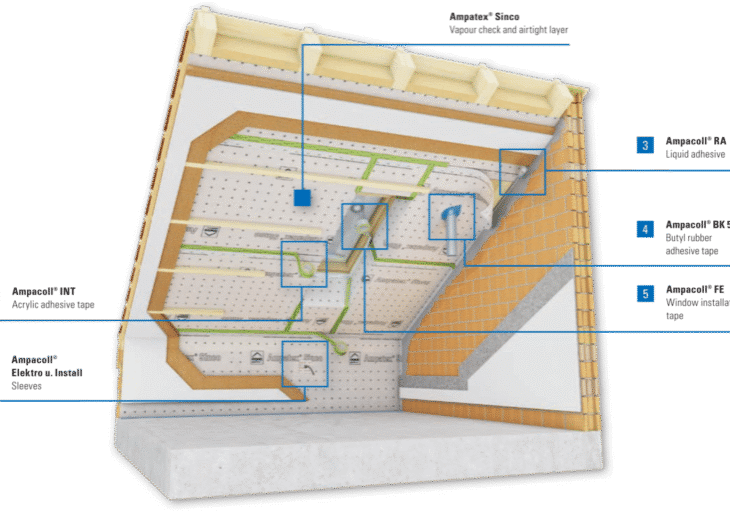
What is a vapour control layer?
Learn what a vapour control layer is, how it works, and why it matters. Is vapour check plasterboard an alternative?


NatureWall Information Pack
Downloadable files and resources taking you through all the checks planning for NatureWall projects.
Fire and wood fibre
One common concern when using wood fire insulation is that because it is made of wood it might not be safe from a fire perspective.
Explore all resources under Planning and Design...
Industry news

https://youtu.be/lCclTxAS3ko
Flat roofs are one of the trickiest roof types to get right, and the covering you choose sits at the heart of whether they perform safely over time. In this episode, Chris and Andy look at what roof coverings work best with unventilated flat roofs, covering everything from SD values and membrane types to why the colour of your roof covering has a direct impact on moisture drying during the summer months. If you're specifying a flat roof build-up with wood fibre insulation, this is an essential watch before you commit to a membrane.
Industry news

https://youtu.be/5AH_I1_Am1I
Retrofit insulation rarely fails in the middle of a wall panel — it's the junctions, apertures, and service penetrations where things go wrong. In this episode, Chris and Andy dig into the details that most commonly cause failures in practice, from incomplete airtightness membranes to poorly handled window reveals, and why a 30% failure rate in IWI schemes is almost always a detailing problem rather than a system one. If you're specifying or installing internal wall insulation, this one's worth your time.
Industry news

https://youtu.be/pppC6-IsT94
In this episode, Chris sits down with Andy to tackle a question that's become increasingly relevant after last week's 30°C+ temperatures across the UK — why do well-insulated homes still overheat? Andy explains that U-values, while important, are just one piece of the puzzle, and that a singular focus on thermal conductivity often leads to buildings that perform well in winter but become uncomfortable in summer. He walks through the key factors at play — airtightness, window orientation, and crucially, the thermal properties of the insulation itself — and makes the case for wood fibre as a material that genuinely addresses the overheating problem. With a decrement delay of over 16 hours compared to around two and a half for fibreglass, wood fibre slows heat movement through the fabric dramatically, meaning peak external temperatures never really make it inside. A timely watch for anyone who's been sweating in a supposedly energy-efficient home.
Industry news

https://www.youtube.com/watch?v=ZblFjoIQG4E
In this episode, Chris sits down with Marion for her first appearance on Can I Just Ask, talking about PAS2035, a subject that's well within her wheelhouse as a retrofit specialist. Marion explains that PAS2035 is a framework designed to make sure retrofit projects are delivered properly, from initial assessment all the way through to post-occupancy evaluation, with the right people involved at every stage. She walks through the key roles (retrofit coordinators, retrofit designers and installers working under the companion standard PAS2030) and clarifies that the scheme only applies to government-funded projects like ECO or Warm Homes Grant. It's a clear, jargon-light breakdown of a framework that affects a huge amount of retrofit activity in the UK but rarely gets explained in plain English.
Industry news

https://www.youtube.com/watch?v=4ueUJENUEVg
Mixing external and internal wall insulation on the same building is sometimes unavoidable, especially where planning or architectural constraints limit what can be done on certain elevations. This episode covers how to manage the junctions between EWI and IWI — keeping the thermal envelope continuous, minimising transitions, and avoiding the cold spots and moisture risks that come from getting the detailing wrong.
Industry news

https://www.youtube.com/watch?v=mlHK_KCallI&t=90s
Not all moisture analysis methods are created equal. The Glaser method is widely used and fine for simpler constructions, but it was never designed for solid masonry walls or vapour-open materials, and it misses too many real-world variables to be reliable. For internal wall insulation projects, dynamic hygrothermal simulation using WUFI gives a far more accurate picture of how moisture moves through a wall over time, helping you avoid the kind of slow moisture build-up that causes serious long-term damage.
Industry news
https://www.youtube.com/watch?v=cypcDAKJ2J8&t=2s
More insulation isn't always better when it comes to internal wall insulation. The safe limits depend on wall type, exposure to weather, and what's embedded in the masonry. Solid brick walls typically allow 60 to 80mm before moisture risk becomes a real concern, while stone walls need an even more cautious approach. The bigger threat isn't always condensation — it's the slow build-up of humidity that can cause timber decay long before any visible damage appears.
Industry news

https://www.youtube.com/watch?v=dro8YdBzHaY
U-values are a useful starting point for retrofit projects, but the right target depends heavily on how you're insulating and what you're working with. Building Regulations point to 0.3 W/m2K for thermal elements, though 0.7 W/m2K is the compliance threshold in certain circumstances. For external insulation, 0.3 is achievable and relatively low risk. For internal insulation, a more conservative 0.5 to 0.7 is often wiser — thinner insulation layers carry less moisture risk and still deliver real comfort improvements.
Industry news

https://www.youtube.com/watch?v=2rSFeUuyHjs
For most natural insulation work, a formal certification isn't essential. What matters far more is attention to detail — a carefully installed 20mm of insulation will outperform a poorly fitted 100mm every time. Natural materials use familiar trade skills, and resources like Fibres Academy mean good guidance is readily available for anyone who wants it. That said, some specific systems like NatureWall do have a recommended training course, not as a box-ticking exercise, but because consistent detailing is what makes the system perform.
Industry news

https://www.youtube.com/watch?v=nK_cA0GXfGs&t=4s
Partial insulation is possible but comes with real risks. Insulating only part of a building creates a mix of warm and cold surfaces, and the colder uninsulated areas end up carrying a greater moisture burden, increasing the risk of condensation and mould. Where insulation stops, thermal bridging becomes a problem too. If a staged approach is necessary, keep the gap between phases short and prioritise a thin continuous layer across the whole envelope over a thick layer in just one area — heat will always find the easiest route out.